|
|
|
|
|
|
|
|
|
|
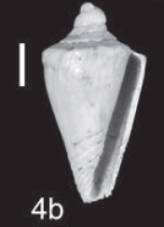
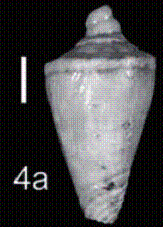
Conus cosmetulus (Cossmann, 1900)
C. testa minuta, valde conica, paulo angusta; spira elata, subextraconica, apice polygyrato et lævigato, anfractibus 6, ad suturam antice crassimarginatis et obtuse crenulatis, inferne biliratis ac plicis incrementi elegantiter decussatis; ultimo anfractu tertiam partem longitudinis fere æquante, ad angulum postioum subcrenulato, undique et profunde arato, et in sulcis subtiliter decussato : apertura perangusta, marginibus parallelis cincta ; labro parum arcuato, haud profunde emarginato ; columella vix intorta ; sulco parietali indistincto.
Taille
petite; forme un peu étroite, régulièrement conique; spire
saillante, à galbe à peine extra-conique, non déprimée à la
périphérie ; tours embryonnaires nombreux, convexes, lisses,
auxquels succèdent six tours presque plans, subimbriqués en avant,
séparés par des sutures peu visibles, avec un gros bourrelet
antérieur, obtusément crénelé ; la rampe postérieure est occupée
par deux sillons spiraux, élégamment croisés par des plis
d’accroissement curvilignes (1).
Dernier
tour à peu près égal aux deux tiers de la longueur totale, séparé
de la spire, à la périphérie inférieure, par un bourrelet
subanguleux, à peine saillant sur le contour, et très obtusément
orné de crénelures confluentes, comme celles des tours de spire;
surface entièrement ornée de profonds sillons spiraux, assez
serrés, finement décussés par les accroissements et régulièrement
espacés, sauf sur'lecou; ‘où'ïls sont un ‘peu plus rapprochés;
en’ devenant plus obliques ; ouverture très étroite, à bords
tout à fait parallèles, terminée en avant par une tronCature non
échancrée; labre peu arqué, peu profondément échancré sur la
spire; columelle à peine tordue à la base; cicatrice pariétale
invisible (1).
Dim.
— Longueur, 12 mill.; diamètre, 5 mill.
“Rapp.
et diff. — Bien que les échantillons que je connais de cette
petite espèce ne soient probablement pas complètement adultes, je
la crois bien distincte des autres Leptoconus
de
Karikal, non seulement par sa forme étroite et par son ornementation
profondément gravée, mais surtout par le galbe de sa spire, qui
occupe presque le tiers de la hauteur totale, en la mesurant jusqu’à
l’angle périphérique du dernier tour, et non pas à partir de la
suture de l’avant-dernier tour ; en outre, les crénelures.
confluentes qui persistent jusqu’au dernier tour, l’ornementation
plus marquée des tours de spire, contribuent à lui donner un aspect
tout à fait spécial, qui ne permet pas de confondre cette coquille
avec les précédentes
(1).
Parmi
les coquilles vivantes, C.
borbonicus
Ad.,
de l’île de la Réunion, a le même galbe et la spire est aussi
crénelée, mais le tour est lisse; C.
sulcifer
Ad.,
de la NouvelleCalédonie, est sillonné et crénelé, mais son galbe
est moins étroit; C.
australis
Chemn.,
est moins conique et a l'ouverture bien plus large, etc
(1).
Assez
rare ; trois échantillons.
Small
in size; somewhat narrow, regularly conical in shape; prominent
spire, with a barely extra-conical curve, not depressed at the
periphery; numerous, convex, smooth embryonic whorls, followed by six
almost flat whorls, subimbricate anteriorly, separated by barely
visible sutures, with a large anterior ridge, obtusely crenulated;
the posterior ramp is occupied by two spiral grooves, elegantly
crossed by curvilinear growth folds
(1).
The
last whorl is approximately two-thirds the total length, separated
from the spire at the lower periphery by a subangular ridge, barely
projecting on the outline, and very obtusely ornamented with
confluent crenulations, like those of the spire whorls; the
surface entirely ornamented with deep,
fairly close, finely decussated spiral grooves, marked by growths
and
regularly spaced, except on the neck. 'where they are 'a little
closer together; becoming more oblique; very narrow aperture, with
perfectly parallel edges, ending anteriorly in an unnotched
truncation; labrum slightly arched, shallowly notched on the spire;
columella barely twisted at the base; parietal scar invisible
(1).
Dimensions
— Length, 12 mm; diameter, 5 mm
“Report
and difference — Although the specimens I know of this small
species are probably not fully mature, I believe it to be quite
distinct from the others: Leptoconus
from
Karikal, not only by its narrow shape and deeply engraved
ornamentation, but especially by the curve of its spire, which
occupies almost a third of the total height, measured to the
peripheral angle of the last whorl, and not from the suture of the
penultimate whorl; moreover, the confluent crenulations that persist
to the last whorl, and the more pronounced ornamentation of the spire
whorls, contribute to giving it a very special appearance, which
makes it impossible to confuse this shell with the preceding ones
(1).
Among
living shells, C.
borbonicus
Ad.,
from Réunion Island, has the same curve and the spire is also
crenulated, but the whorl is smooth; C.
sulcifer
Ad.,
from New Caledonia, is grooved.” and crenellated, but its curve is
less narrow; C.
australis
Chemn.,
is less conical and has a much wider aperture, etc
(1).
Quite
rare; three specimens.
Epoca: Pliocene
Località: India, Java, Giappone
|
|
|
|
|
|
|
|
|
|
Conus sp. |
|
|
|
|
|
|
|
|
|
|
|